
English| EUR
Suggested for you
More currencies
Choose a language
Truffle hunting in Langhe is a centuries-old practice that pairs trained dogs with licensed hunters to locate rare white truffles buried beneath oak, hazel, and poplar roots. The region's clay-limestone soil and microclimate make it the global epicenter for Tuber magnatum pico, the Alba white truffle. Experiences run year-round, with peak season from October through January when white truffles mature.
Quick answer
Truffle hunting is the practice of using specially trained dogs to locate underground truffles in forests, primarily in Langhe's Piedmont hills. Hunters work before dawn when scent conditions are optimal, following dogs that detect the pungent aroma of mature truffles hidden 5–30 centimeters below the surface. The region is accessible year-round at no entrance fee, though private truffle hunts are bookable experiences led by licensed trifolau (truffle hunters) with individual pricing set by operators.
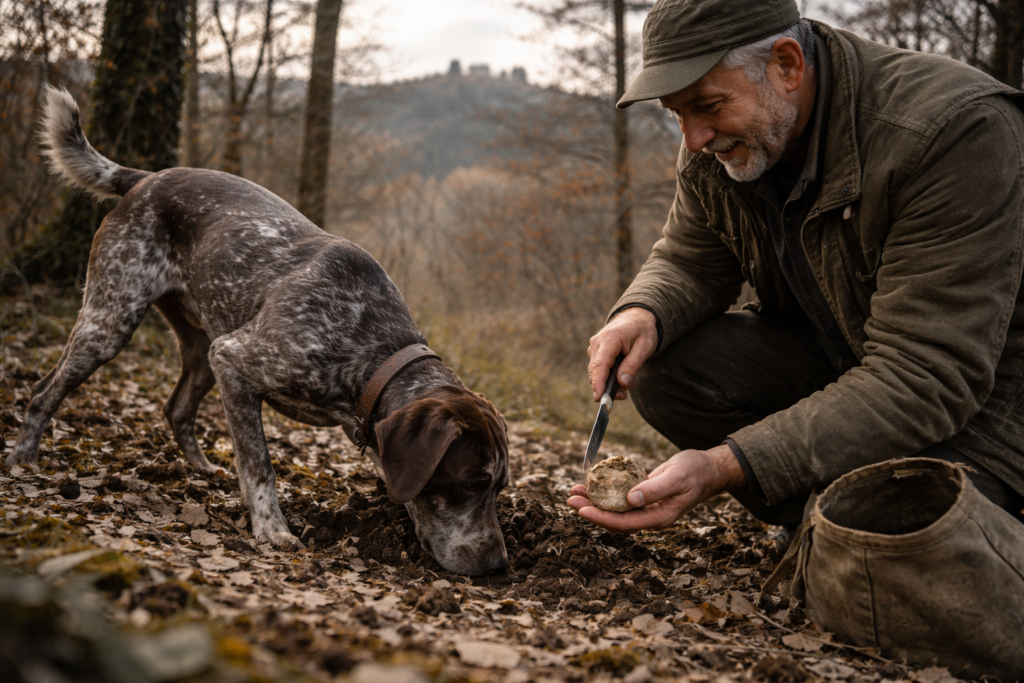
A single white truffle from Langhe sold for €103,000 at auction in 2024, but the hunt itself costs nothing more than permission and a trained nose. What is truffle hunting in its essence? It is a pre-dawn pursuit through oak and hazel groves, where Lagotto Romagnolo dogs and mixed-breed truffle hounds work scent trails invisible to humans. The trifolau — Piedmont's licensed truffle hunters — carry a vanghetto, a narrow spade designed to extract truffles without damaging roots or disturbing the symbiotic mycorrhizae that produce future harvests. The tradition dates to the 15th century, when pigs were the preferred hunters until dogs proved easier to control and less likely to devour the prize. Today's truffle-hunting dogs begin training at eight weeks, learning to distinguish the sulfurous aroma of ripe Tuber magnatum from decoy scents buried in training fields. The best dogs can detect a truffle from 50 meters in optimal conditions — cool soil, high humidity, and minimal wind. Hunts occur in the hours before sunrise, when ground temperatures stabilize and competing scents dissipate. Langhe's truffle grounds span the municipalities of Alba, Barolo, Barbaresco, and the Alta Langa, where calcium-rich marl meets clay in the ratios truffles require. White truffles fruit from late September through January, while black summer truffles appear May through August. Hunters guard their productive zones with the secrecy of Barolo vintners, returning to the same root systems for decades. A dog may dig thirty false starts in a morning and uncover a single 40-gram truffle worth a week's wages. Visitors join working hunts by booking directly with licensed trifolau or through regional tour operators. Most experiences last two to three hours and include a tasting component where freshly shaved truffle is paired with tajarin pasta or farm eggs. The Langhe region itself is free to enter and explore, with truffle hunting representing one thread in a broader tapestry of wine estates, hazelnut groves, and medieval hilltop villages. No special gear is required beyond weather-appropriate footwear, though hunters appreciate guests who understand that silence improves a dog's focus and that not every outing yields a trophy specimen.
“A dog may dig thirty false starts in a morning and uncover a single 40-gram truffle worth a week's wages.”
Truffle hunting in the Langhe follows a centuries-old partnership between trained dogs and experienced trifolau (truffle hunters) who read the forest floor for signs of buried treasure. A typical hunt lasts two to four hours, moving through oak and hazelnut groves where white and black truffles grow.
Your hunter introduces the trained Lagotto Romagnolo or mixed-breed dog that will lead the search. Many hunters work with dogs they've trained from puppies, and the animal's behavior signals the start of the hunt.
The dog moves freely, nose to ground, zigzagging across areas the hunter knows from years of observation. You walk behind, watching for the moment the dog freezes and begins pawing at a spot.
When the dog indicates a find, the hunter uses a small handpick called a vanghetto to gently uncover the truffle without damaging it or disturbing surrounding mycelium. The dog receives a treat as reward, reinforcing the behavior.
The hunter explains the differences between Tuber magnatum (white truffle, October–December) and Tuber melanosporum (black truffle, November–March) based on appearance, aroma, and the soil conditions where each grows.
You're invited to hold the truffles and smell their earthy, garlicky aroma. The hunter discusses quality markers like firmness, color, and scent intensity that determine culinary and market value.
Truffle hunting experiences in the Langhe region are private, scheduled activities rather than fixed-venue operations. Consequently, they operate based on the availability of individual truffle hunters.
The prime window for truffle hunting in the Langhe region spans from late September to January, when the prized white truffle (*Tuber magnatum pico*) reaches peak maturity. Hunting is most effective during cooler hours when canine olfactory performance is at its highest.
Mild, 10°C to 18°C
White truffle season peaks during the International Alba White Truffle Fair.
Cold, 0°C to 7°C
Season for black winter truffles and final white truffle harvests.
Warm, 20°C to 30°C
Summer black truffle season offers longer days but requires early morning starts for dog comfort.
Verdict: The best period is mid-October through November for the white truffle harvest, focusing on early morning hunts to optimize canine performance.
Access to the Langhe region for truffle hunting is free of charge. Participation in organized truffle hunting experiences requires fees paid directly to private operators.
Verdict: There is no official entry fee to the region, and total costs depend entirely on the specific private tour operator selected.
Truffle hunting is a collaboration between hunter, dog, and land. Respecting the dog's work and the forager's expertise ensures a productive experience and protects the delicate truffle ecosystem.
Truffle hunting in Langhe's wooded hills requires appropriate gear for uneven forest terrain and variable weather conditions.
Everything you need to know about what is truffle hunting
In the Langhe, what is truffle hunting involves walking through forests with a trained dog to locate subterranean fungi. It is a traditional practice that focuses on the deep bond between the hunter and their canine companion. Learning about the ecology of the Piedmont landscape is central to understanding what is truffle hunting as a cultural heritage. This immersive woodland activity offers a unique perspective on the regional gastronomy found in Italy.
Because experiences are private bookings, scheduling depends on individual hunter availability. We recommend arranging your outing well ahead of your travel dates to ensure your preferred time slot. You can find available time slots through our booking tools.
Entrance to the Langhe region is 0 EUR, so there is no public fee to explore the territory. However, private operators charge individual fees for their guided services and expert knowledge. Please check the booking widget for current pricing on specific professional tours.
Many operators welcome visitors of all ages to join these woodland walks. Children often enjoy watching the dogs work, provided they can handle the terrain of a forest search. It is a gentle outdoor activity that highlights the natural beauty of the local habitat.
Since you will be trekking through forest soil and uneven terrain, durable outdoor footwear is essential. We advise wearing comfortable clothing that you do not mind getting dirty during the forage. Dressing in layers is helpful for adapting to the fluctuating woodland temperatures.
The seasonal availability depends on the specific variety of fungus, such as the white or black types. While you can inquire about what is truffle hunting experiences at any time, the active harvest seasons follow strict regional calendars. Check our scheduling interface for the most current availability by date.
If the dog unearths a specimen, it typically belongs to the professional hunter leading the excursion. These findings are often used in local culinary demonstrations or sold to supply nearby restaurants. Participants gain the unique opportunity to see these rare ingredients in their natural environment.